Some courses from the Plasticité school are available: Please connect to sciencesconf to download from the NAVIGATION menu
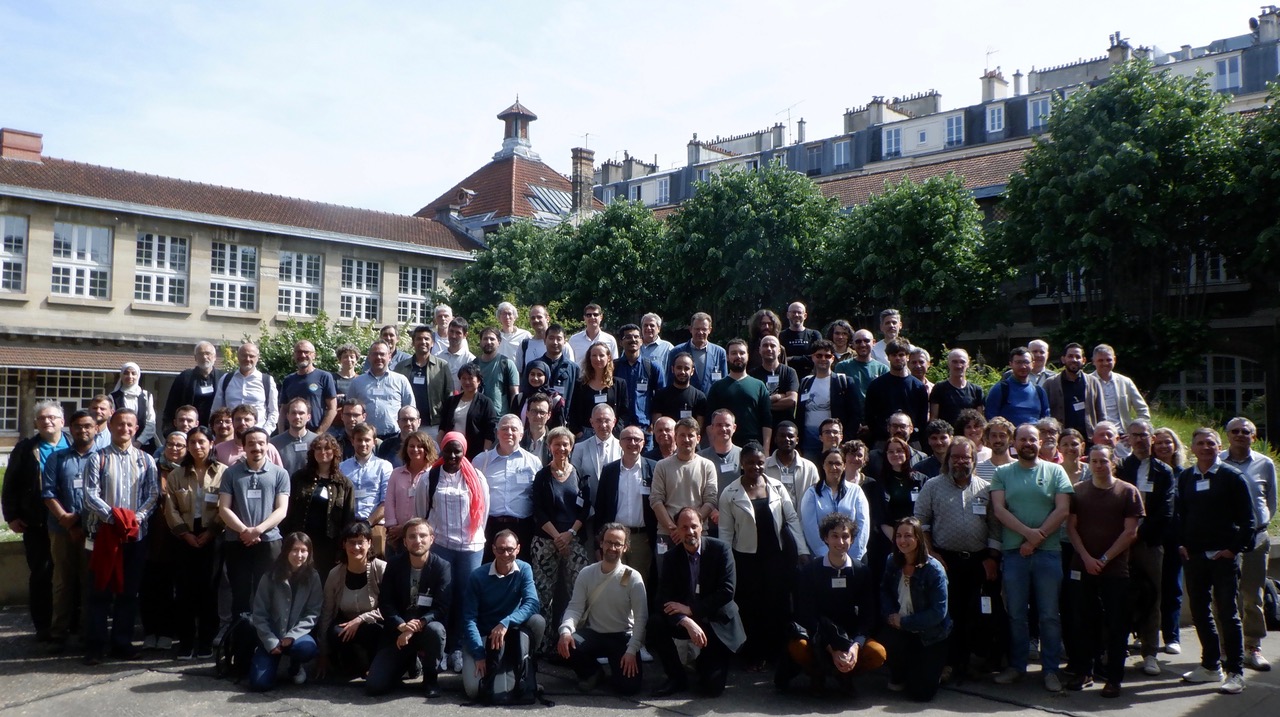
Photo of the conference
Colloquium booklet
The conference booklet is available for download here.
Announcement : gala dinner (29th of April 2026)
The gala dinner took place on the first floor of the Eiffel tower at the Madame Brasserie restaurant
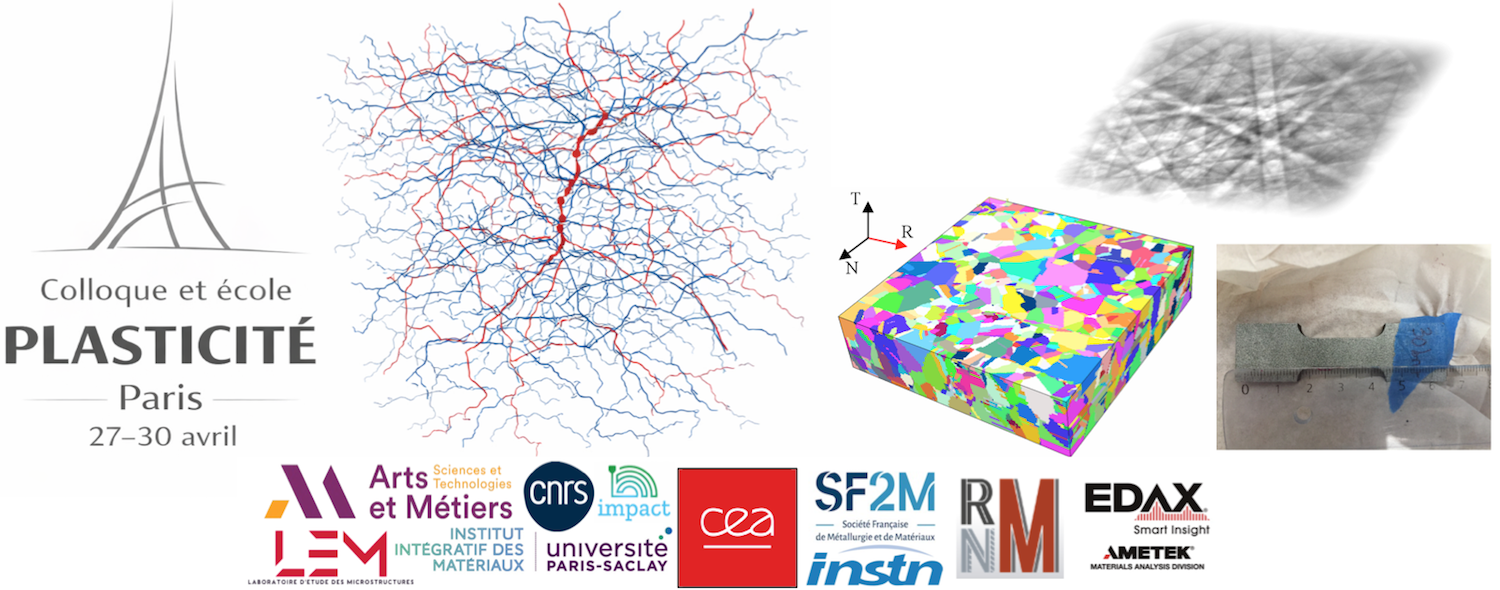
Plasticity 2026
For over 50 years, the Plasticity Symposium has been the annual meeting place for the national community of researchers interested in the physical processes governing the plastic deformation of materials.The studies presented cover all types of materials: metallic materials (steels, light alloys, etc.), ceramic materials (semiconductors, glasses, etc.), as well as new materials (composites, granular materials, nanostructured materials, polymers, foams, eco-materials, etc.).
This research field also spans multiple scales: from the nanometric scale, with the study of elementary plasticity mechanisms, to the macroscopic scale, with the laws of mechanical behavior of materials.These topics are covered by both experimental and numerical approaches.
This edition will be preceded by a training day on plasticity primarily aimed at young researchers (doctoral or postdoctoral students).The participants, numbering between 70 and 120 each year, include a significant number of young researchers and doctoral students.The Plasticity Symposium provides them with an opportunity to gain initial experience before an audience of seasoned specialists.It is an event where contacts are made and collaborative networks are forged.Furthermore, even though the Plasticity Symposium is a national event, our international colleagues, who regularly attend, are always welcome.The symposium's objectives are, of course, to contribute to the sharing and discussion of recent concepts and findings related to plasticity.For the research community interested in plasticity, it offers a regular opportunity to meet, fostering the exchange of ideas and the emergence of innovative research themes.Moreover, the Plasticity Symposium plays a major role in the training of young researchers, facilitating exchanges between teams, and contributing to the renewal of national research teams.For doctoral students nearing the end of their dissertations, it provides an opportunity to raise their profile and thus prepare for their post-doctoral careers.
For this inaugural year of a school preceding the Plasticity Symposium, the unifying theme of dislocation's mobility has been chosen. It aims to provide foundational knowledge, both experimental and theoretical (including numerical simulation methods), on this fundamental topic. The school will cover various aspects of dislocation motion, often neglected in initial training programs (Peierls stress, viscosity and radiative effects, alloying effects, experimental challenges, etc.).
Two half-days will be held on the afternoon of April 27 and the morning of April 28, with four 90-minute lectures. This training is intended for young researchers, PhD students, and postdoctoral fellows. Priority for available places will be given to students and young researchers participating in the symposium. There is no registration fee for this mini-school.
The selected speakers are as follows:
Frédéric Mompiou (CEMES, CNRS, Université de Toulouse)
 Loading...